











Bryan Szeglin, MD (he/him/his)
Resident Physician
The Johns Hopkins Hospital
The Johns Hopkins Hospital
Baltimore, MD, United States
All disclosed relationships have been reviewed and managed prior to the start of this activity. Any relevant relationships will be listed below. This individual has no financial relationships to disclose
Stefano Tassinari, MD
General Surgery Resident
Johns Hopkins Hospital
Laurel, MD, United States
Disclosure information not submitted.

Sophia Diaz, MD, MSE (she/her/hers)
Surgical Resident Physician
Johns Hopkins University
Baltimore, MD, United States
Disclosure information not submitted.
Miloslawa Stem, MS
Research Associate
Johns Hopkins School of Medicine
Balitmore, Maryland, United States
Disclosure information not submitted.
Alodia Gabre-Kidan, MD, MPH
Assistant Professor of Surgery
Johns Hopkins School of Medicine
Baltimore, Maryland, United States
Disclosure information not submitted.

Andrea C. Bafford, MD
Associate Professor of Clinical Surgery
Johns Hopkins University School of Medicine
Baltimore, MD, United States
Disclosure information not submitted.
Ada E. Graham, MD
Assistant Professor of Surgery
Johns Hopkins University
Bethesda, Maryland, United States
Disclosure information not submitted.
John Migaly, MD
Associate Professor
Johns Hopkins University
Baltimore, Maryland, United States
Disclosure information not submitted.
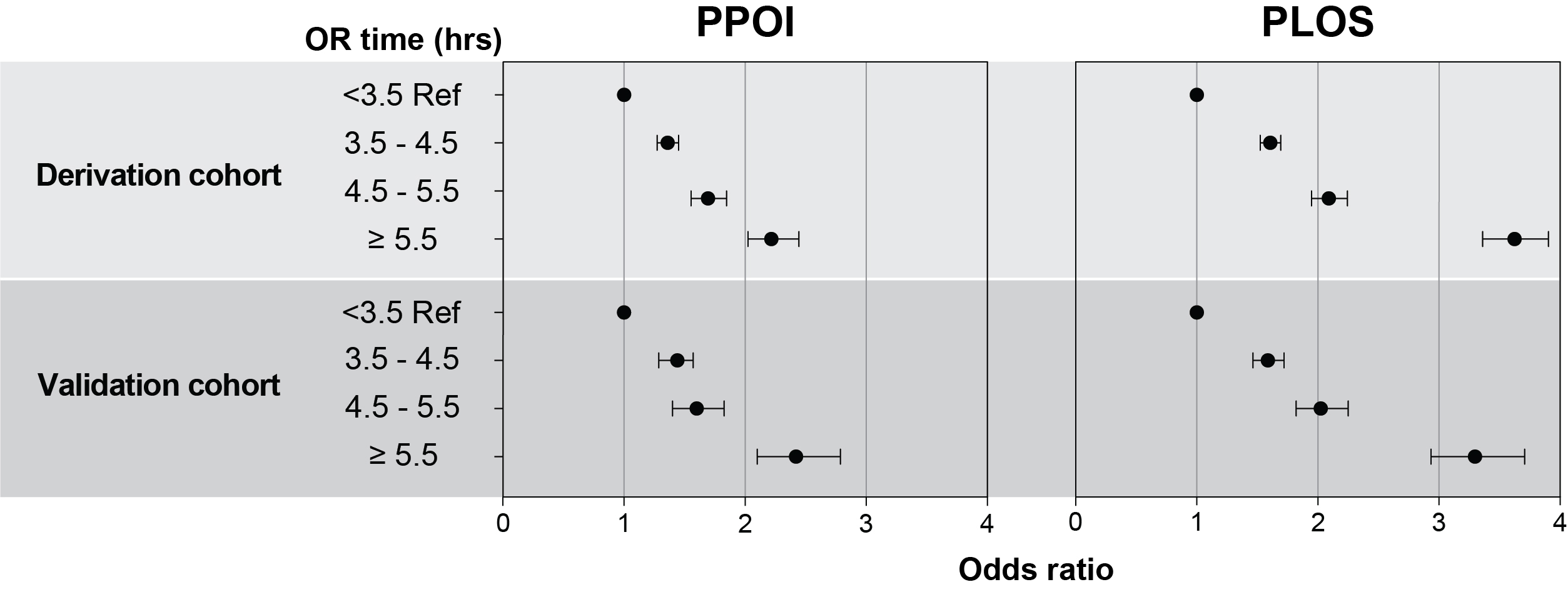 Forest plot illustrating the odds of prolonged postoperative ileus (PPOI) and prolonged length of stay (PLOS) across increasing operative times in both the derivation and validation cohorts. A threshold of 3.5 hours was identified (Youden Index) as the point at which prolonged operative time becomes significantly associated with worse odds and was used as the reference for odds ratio calculations. The multivariable logistic regression models were adjusted for age, sex, race, BMI, pre-operative comorbidities, chemotherapy, bowel prep, indication, American Society of Anesthesiologists classification, and case year. All operative time categories were significantly associated with PPOI and PLOS (P < 0.0001). Error bars represent 95% confidence intervals.